History Walk and Wheel
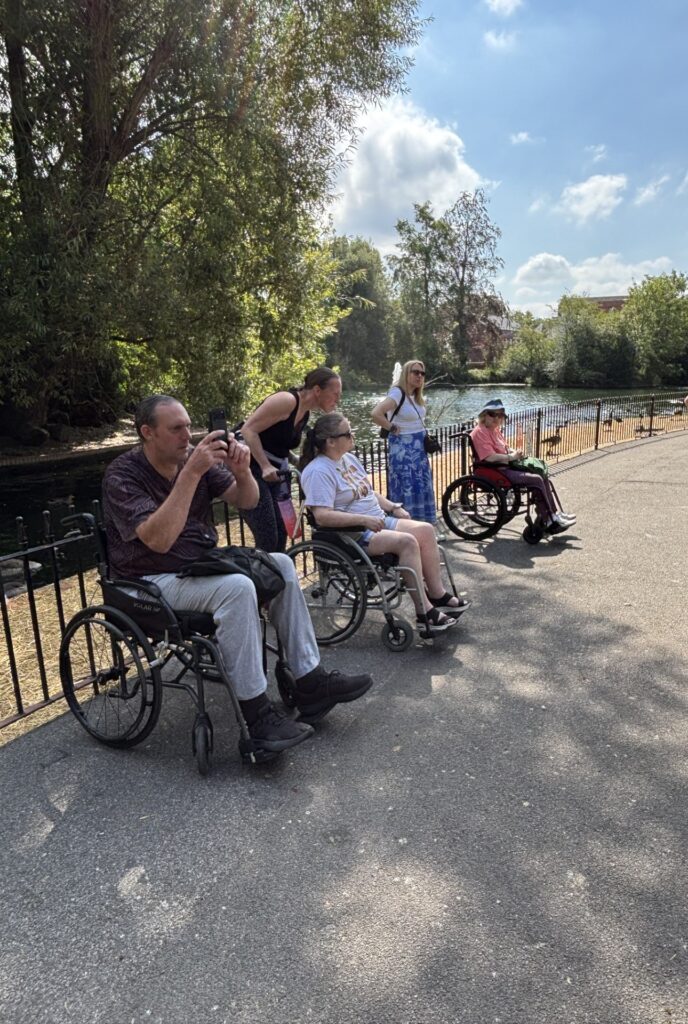
On the 15th July a group of Coalition staff and members took part in the second of our Thames Water Funded Engaging with Rivers Project. This time we visited Bourne Hall in Ewell and the Hogsmill River. We enjoyed a history tour along the Hogsmill with our guide before returning to Bourne Hall to explore some historical artefacts and create some brass rubbings with their museum curator.
Once again we had a hot and sunny day and we were grateful of the cooler air under the trees by the river. Bourne Hall is currently a community hub housing Ewell library, a local history museum and the Flying Saucer café in a 70’s listed building that looks like a flying saucer! The landscaped gardens and river Hogsmill that surrounds it though gives a clue to a fascinating historical past.
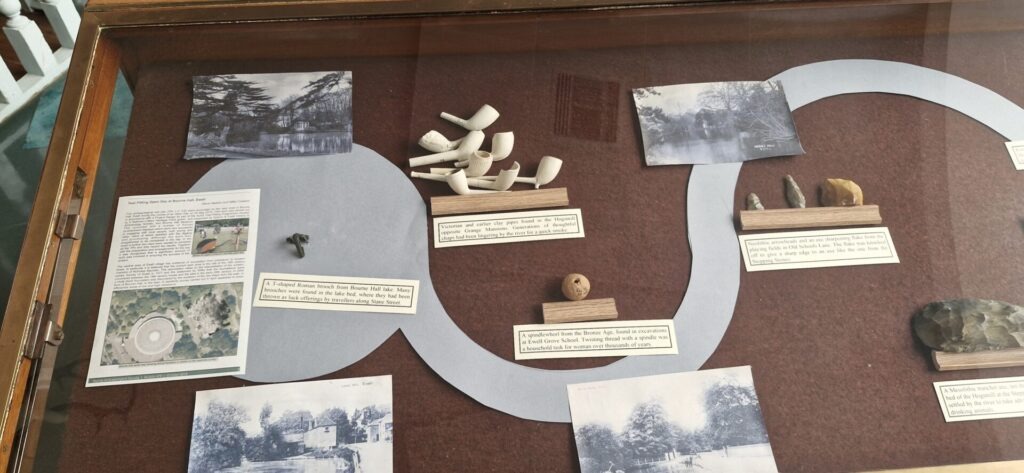
In front of the hall, is a formal lake which is actually one of several springs that form the source of the river Hogsmill. In fact, the name Ewell comes from the old English word Æwell meaning river source or spring. The springs are here because the chalk of the north downs meets the London clay, so the rainwater stored in the chalk aquifer is pushed up to the surface. The Hogsmill flows from Ewell to the Thames at Kingston and is only about 6 miles (10km) long. This water supply means there has been settlement here since prehistoric times and in fact, neolithic remains have been found by the river. Roman remains have also been found suggesting a sizable settlement here on the route of Stane Street the Roman road from Chichester to London. The formal gardens came when Garbrand Hall was built on the site in the 1770’s for Philip Rowden a prosperous London wine merchant. All that remains of the Georgian manor house now is the lodge and Dog Gate which we passed as we left the park and went out onto Spring Street.
Outside of Bourne Hall is another spring known locally as horse pond and from here the springs join up and the Hogsmill river proper starts. We took a gentle walk and wheel alongside the river up to Upper Mill. Although it’s only a small river the Hogsmill used to have sufficient enough flow to power several mills. Primarily, corn and flour mill but also paper mills and even the incredibly dangerous gunpowder mills. In fact, it was rumoured that the French lost the Franco-Prussian war because they used poor-quality gunpowder manufactured in Ewell! In the 20th century with increased urbanisation and therefore demands on the water supply, the flow of the river lessened dramatically and the mills were closed.
We returned to Bourne Hall for the second part of our trip. We were able to handle and explore a wide selection of everyday Victorian objects and wartime artefacts, before heading up to the museum for some brass rubbing on replicas of monumental brasses from nearby St Mary the Virgin church. Then, of course, it was time for a cuppa and cake!
Contact Information
Address
Surrey Coalition of Disabled People
Astolat, Coniers Way
Burpham, GU4 7HL